

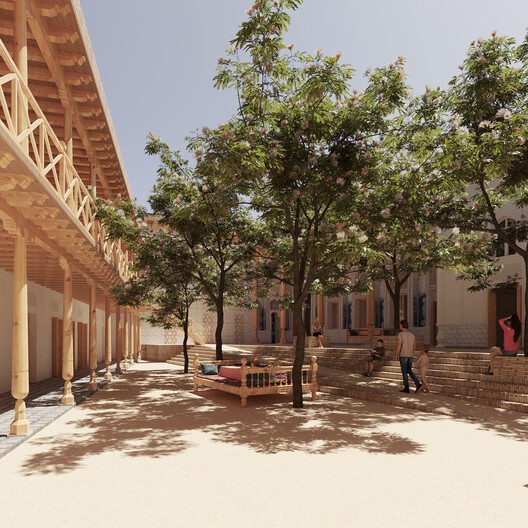
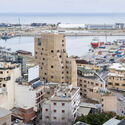
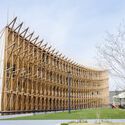
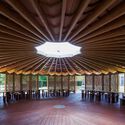
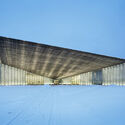
Known today for her poetic yet rigorous approach to architecture, Lina Ghotmeh has become one of the most compelling voices in contemporary design. Her work spans continents, from the British Museum's Western Range redesign in London to AlUla's Contemporary Art Museum, and includes landmark commissions such as the Serpentine Pavilion in London, Stone Garden in Beirut, the Bahrain Pavilion at the 2025 Expo Osaka, and the Estonian National Museum in Tartu, Estonia which she won the competition to design at just 25. Through a palimpsest of projects, Ghotmeh has established a distinctive architectural language that bridges memory and contemporary life. Wherever she builds, her process captures a constant dialogue between people, place, past and future.
Born and raised in Beirut during the Lebanese Civil War, Ghotmeh grew up in a city continually destroyed and rebuilt, a landscape of memory, resilience, and renewal. This experience profoundly shaped her understanding of architecture, which she often describes as both "an act of resistance and a vessel of empathy." For her, it is not about nostalgia but about transforming the scars of the past into spaces of hope, community, and continuity.


